Introduction
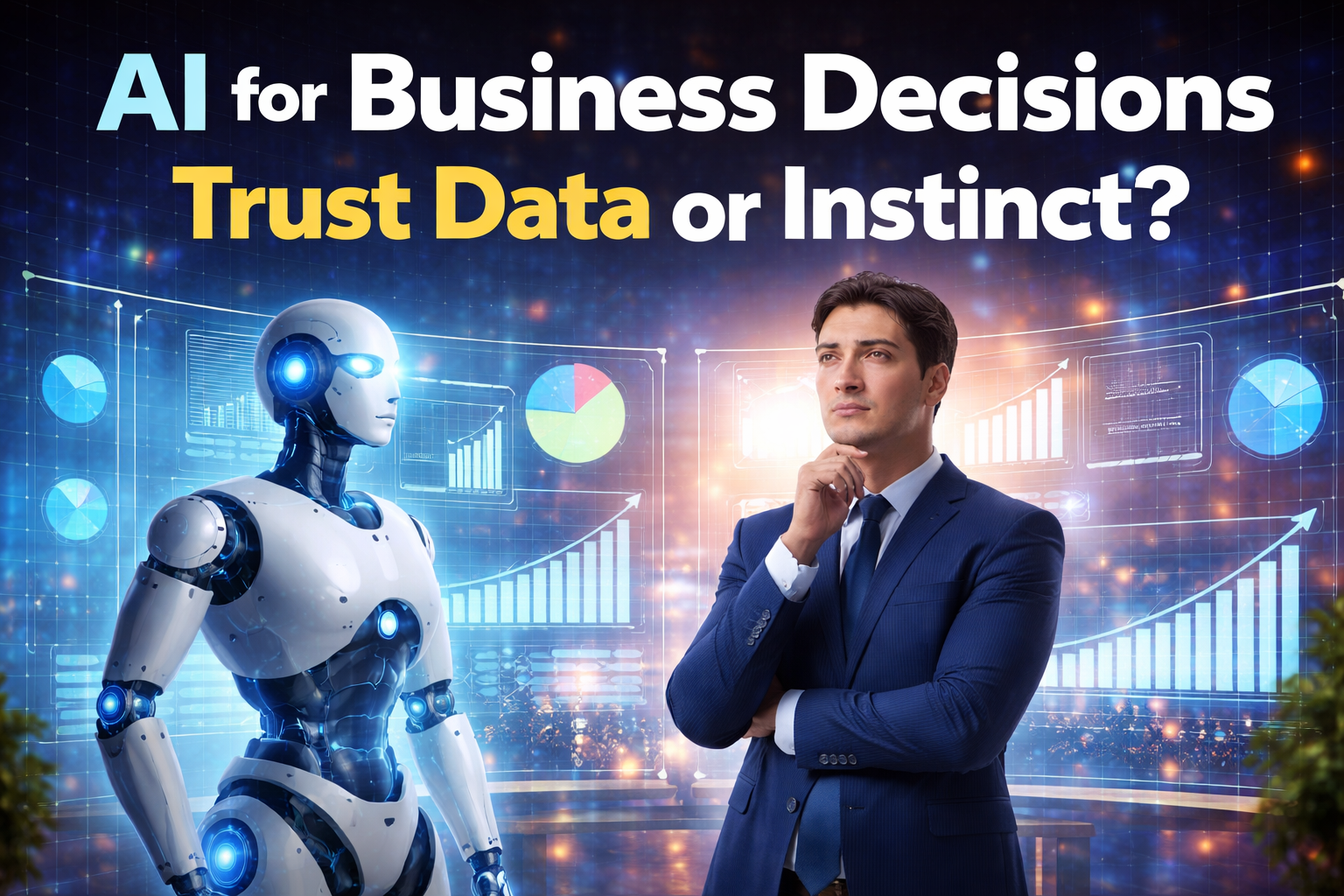
In the modern business landscape, leaders are faced with constant decision-making challenges. From launching products and adjusting marketing strategies to managing resources and financial planning, the stakes are higher than ever. Traditionally, business leaders relied on instinct and experience to guide their choices, trusting gut feelings when data was scarce. Today, however, artificial intelligence (AI) has revolutionized how decisions are made, offering data-driven insights that can significantly improve outcomes. This raises an important question: should businesses trust data more than instinct, or is there a balance to be struck?
To understand how AI works in decision-making, you can explore this detailed guide on
Artificial Intelligence.
The Rise of Data-Driven Decision Making
AI for business decisions allows organizations to process and analyze massive amounts of data quickly and accurately. Unlike instinct, which can be influenced by emotion or bias, AI provides objective insights based on historical and real-time information.
Companies can now predict customer behavior, market trends, and operational challenges, making decisions that are not only faster but also more precise. Leading brands such as Amazon and Netflix rely heavily on AI algorithms to recommend products, forecast demand, and optimize strategies, demonstrating the power of data in shaping business outcomes.
The Role of Human Instinct
While AI offers precision and objectivity, human instinct remains invaluable. Instinct draws from experience, intuition, and understanding of context—factors that data alone may not capture. However, relying solely on instinct carries risks. Cognitive biases like overconfidence, confirmation bias, and recency bias can lead to flawed decisions, especially in complex environments where multiple variables interact.
For instance, a CEO may feel confident launching a new product because of past successes. AI analysis, however, could reveal shifting customer preferences or emerging competitor threats. Ignoring these data-driven insights can result in costly mistakes.
Businesses today rely heavily on
data-driven decision making
to improve performance and reduce risks.
Finding the Perfect Balance
The most effective decision-making combines AI insights with human intuition. AI can process large datasets, detect patterns, and forecast outcomes, while leaders interpret these results within the broader business context. This approach allows companies to consider qualitative elements such as company culture, employee morale, brand reputation, and ethical considerations—areas where AI alone cannot provide guidance.
For example, AI might suggest downsizing a department to improve efficiency. While the data supports the decision, a leader’s instinct might recognize potential long-term impacts on team cohesion and innovation. By combining AI and human judgment, businesses achieve balanced, strategic, and sustainable decisions.
Key Benefits of Using AI in Business Decisions
- Accuracy and Objectivity: Reduces errors and emotional bias.
- Speed and Scalability: Processes massive datasets quickly, enabling faster decision-making.
- Predictive Insights: Identifies trends, customer preferences, and market shifts.
- Operational Efficiency: Frees leaders to focus on strategy rather than manual data analysis.
Challenges and Considerations
AI is powerful but not infallible. The quality of decisions depends on accurate, clean data and well-designed algorithms. Poor or biased data can lead to flawed recommendations. Additionally, over-reliance on AI may suppress creativity, intuition, and critical thinking—essential components of innovation and strategic planning.
You can also read our guide on
AI for Zero Experience Entrepreneurs
to understand how AI helps beginners start a business.
Conclusion
AI and human instinct are most effective when used together. Data provides clarity, uncovers opportunities, and reduces risk, while instinct adds context, empathy, and strategic foresight. By leveraging AI insights and validating them with experience, businesses can make decisions that are intelligent, balanced, and human-centered. In today’s competitive environment, the smartest organizations are those that trust data and instinct equally, creating a powerful synergy that drives success.